
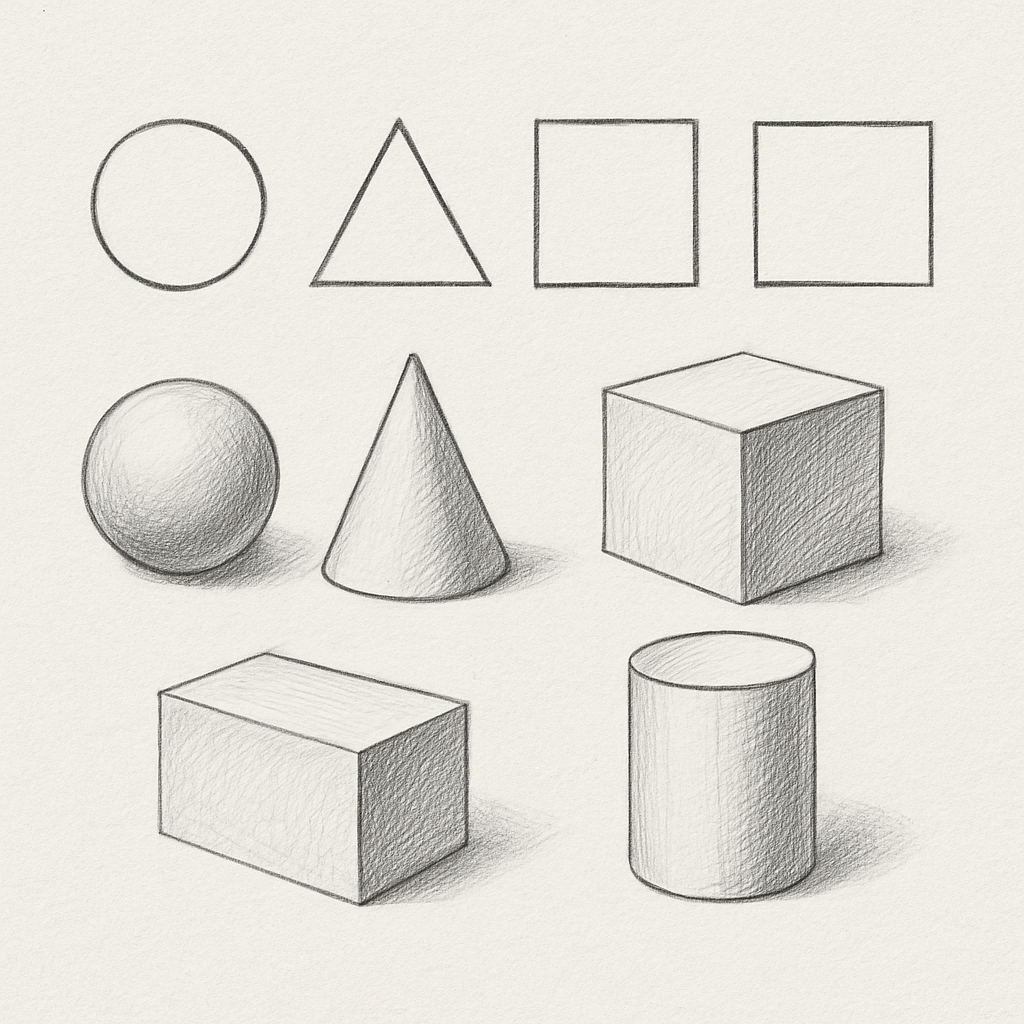
A blank page is not actually empty. For a beginning artist, it is full of invisible decisions. What should I draw? Where should it go? How big should it be? What line should I use? What happens if the first mark is wrong?
That is why a student can sit in front of a clean sheet of paper and look as though nothing is happening. Something is happening. The student is meeting too many choices at the same time.
Adults often describe this as a confidence problem. Sometimes it is. But in a drawing lesson, confidence usually follows action. A student needs a first useful move before they can feel capable. Telling a beginner to “just be creative” can accidentally make the lesson harder, because it gives encouragement without reducing the number of decisions.
Beginners need fewer decisions at the start.
Experienced artists forget how many small decisions they make automatically. They choose scale, placement, proportion, line weight, and correction without stopping to name each one. A beginner has not built that internal sequence yet.
A guided drawing lesson helps by narrowing the first few decisions. It does not remove thinking. It organizes thinking. The student still has to look, compare, move the pencil, adjust a line, and decide what to do next. But the lesson gives the work a beginning shape.
Guided drawing is not the opposite of creativity. Used well, it is the scaffolding that helps a student reach creative independence.
Structure is not the same as copying.
There is a weak version of guided drawing where the goal is only to copy a final picture. That can be fun, but it does not always build transferable skill. Torch & Trowel is aiming at something different: a guided path that teaches line control, observation, shape, form, and attention.
The point is not for the student to follow instructions forever. The point is for the student to practice the smaller skills that eventually make independent drawing possible.
This is why a good beginner lesson should not only say, “Draw this.” It should quietly teach what the student is practicing: pressure, direction, spacing, proportion, negative space, or the way a flat shape can become a form.
A useful worksheet gives the student somewhere to begin.
A worksheet can be busy and shallow, or it can be clear and purposeful. The difference is in the sequence. A strong drawing worksheet is not just a page of prompts. It is a learning path that asks the student to practice the next skill at the right size, in the right order, with enough support to continue.
That is the reason Torch & Trowel separates the student page from the parent notes. The student page stays clean. The parent notes carry examples, reminders, and prompts. The student can work without visual clutter, and the parent has help nearby without needing to perform a full art lecture.
The goal is independence, not dependence.
Blank pages matter. Students should eventually learn to begin their own drawings, choose subjects, make plans, and work through uncertainty. But independence is a destination, not always the best starting point.
A beginner who learns to control a line, see simple shapes, notice empty space, and build forms is becoming more independent. A guided lesson can make that growth visible. The page gives the student a place to start, and the repeated practice gives the student a reason to keep going.
So if a blank page keeps freezing the lesson, do not begin with the blank page. Begin with structure. Begin with one clear mark. Begin with a task small enough that the student can do it, then let that action become confidence.