You need structure.
A good curriculum should tell you what to print, what skill is being practiced, what to notice, and when to stop.

Parent decision guide
Most parents are not asking for a prettier art website. They are asking a practical question: which kind of art curriculum will actually work in our home, with our student, without turning the day into a production?
The real buyer question
A good curriculum should tell you what to print, what skill is being practiced, what to notice, and when to stop.
The page should not be so crowded with instruction that the student has nowhere to draw or think.
You should not have to draw a perfect example before the lesson can begin.
Compare the real options
Some resources entertain, some outsource the teaching, and some give practice without much instruction. Torch & Trowel is workbook-like, but the lessons are sequenced and scaffolded from years of teaching real students.
Good for demonstration, but it adds device setup and can make the student dependent on replaying.
Clean and affordable, but many workbooks leave the learning sequence and stuck moments to the parent.
Best fit for middle and high school students who need screen-free structure, skill progression, and parent notes without another app.
See the Field Kit| Option | Best for | Prep and materials | Parent skill needed | Tradeoff |
|---|---|---|---|---|
| Video art lessons | Families who want demonstration and a teacher on screen. | Low prep, but device setup and screen management are part of the lesson. | Low. The video carries most of the teaching. | Students may copy passively or become dependent on pausing and replaying. |
| Craft/project books | Younger students, seasonal projects, and quick wins. | Often requires special supplies, color materials, or parent gathering time. | Low to medium, depending on the project. | Fun output, but skill progression can be uneven. |
| Simple drawing workbooks | Independent practice, extra pages, and simple drawing prompts. | Usually simple: book plus pencil. | Medium. Parent may need to supply the teaching sequence or explain stuck points. | Useful for practice, but often light on scaffolding and feedback. |
| Co-op or private class | Families who want live feedback, accountability, and outside instruction. | Scheduling, travel, tuition, and materials vary. | Low at home because the teacher carries instruction. | More expensive and less flexible than printable curriculum. |
| Recommended fitTorch & Trowel Field Kit | Middle and high school students who need a structured path into real drawing skills. | Print the student pages and parent notes; use a pencil and eraser. | Low to medium. The parent notes give examples, prompts, and reminders. | Best when you want scaffolded skill growth more than one-off projects. |
Good fit
Not the best fit
Use the five principles as the filter
If you want drawing foundations without more screen time, more supply prep, or more parent performance, judge every option by the same five commitments.
Does it teach drawing foundations, not only finished projects?
Does it reduce device dependence during the school day?
Can parent and student understand what to do next?
Can you start without a supply hunt?
Can the work be used, repeated, and marked up?
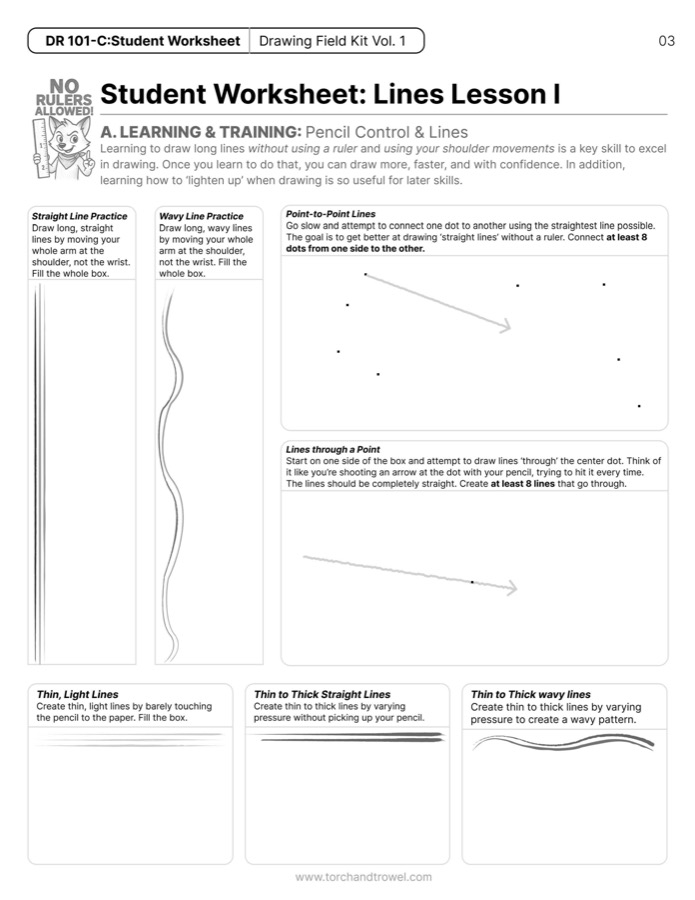
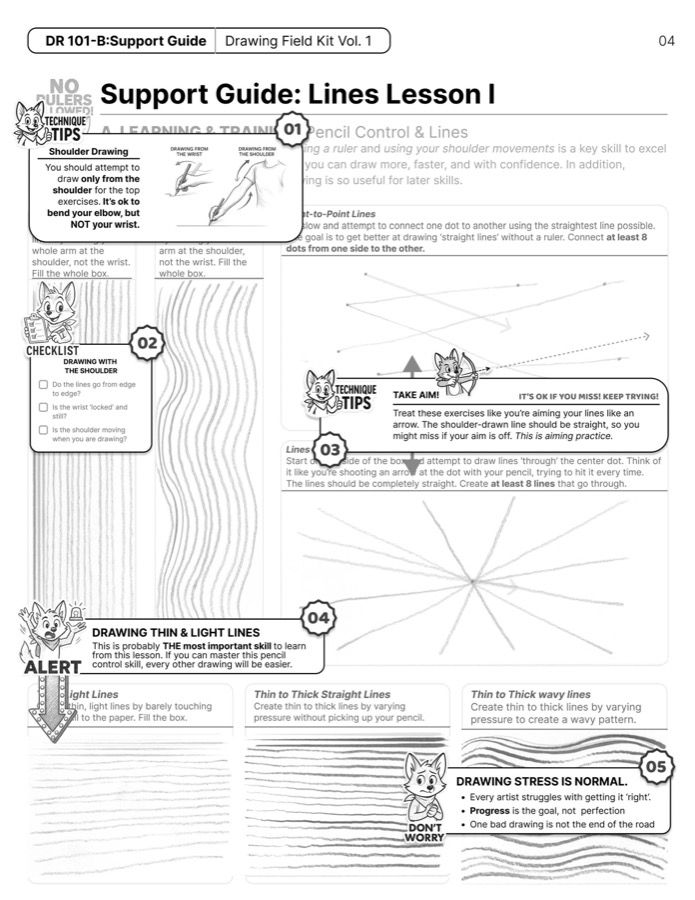
Lowest-risk next step
The free lesson lets you test the actual rhythm: student worksheet, matching parent notes, pencil, and about 30 minutes at the table.
Friction, follow-through, and fit
If every lesson requires supply hunting, video setup, or parent improvising, the curriculum will be harder to repeat.
Video can help demonstration, but it also puts another screen in the school day. Printable lessons keep attention on the page.
If you feel like you must perform the art lesson perfectly, you may avoid starting. Parent notes should lower that pressure.
Projects can be fun, but students also need control, observation, shape, form, and practice over time.
Our recommendation
The fastest way to know if Torch & Trowel fits your family is to try the free lesson. Print it, give your student the worksheet, keep the parent notes beside you, and see whether the rhythm works at your table.